
The VPP Value Chain: Why Coverage Matters More Than Technology

Introduction
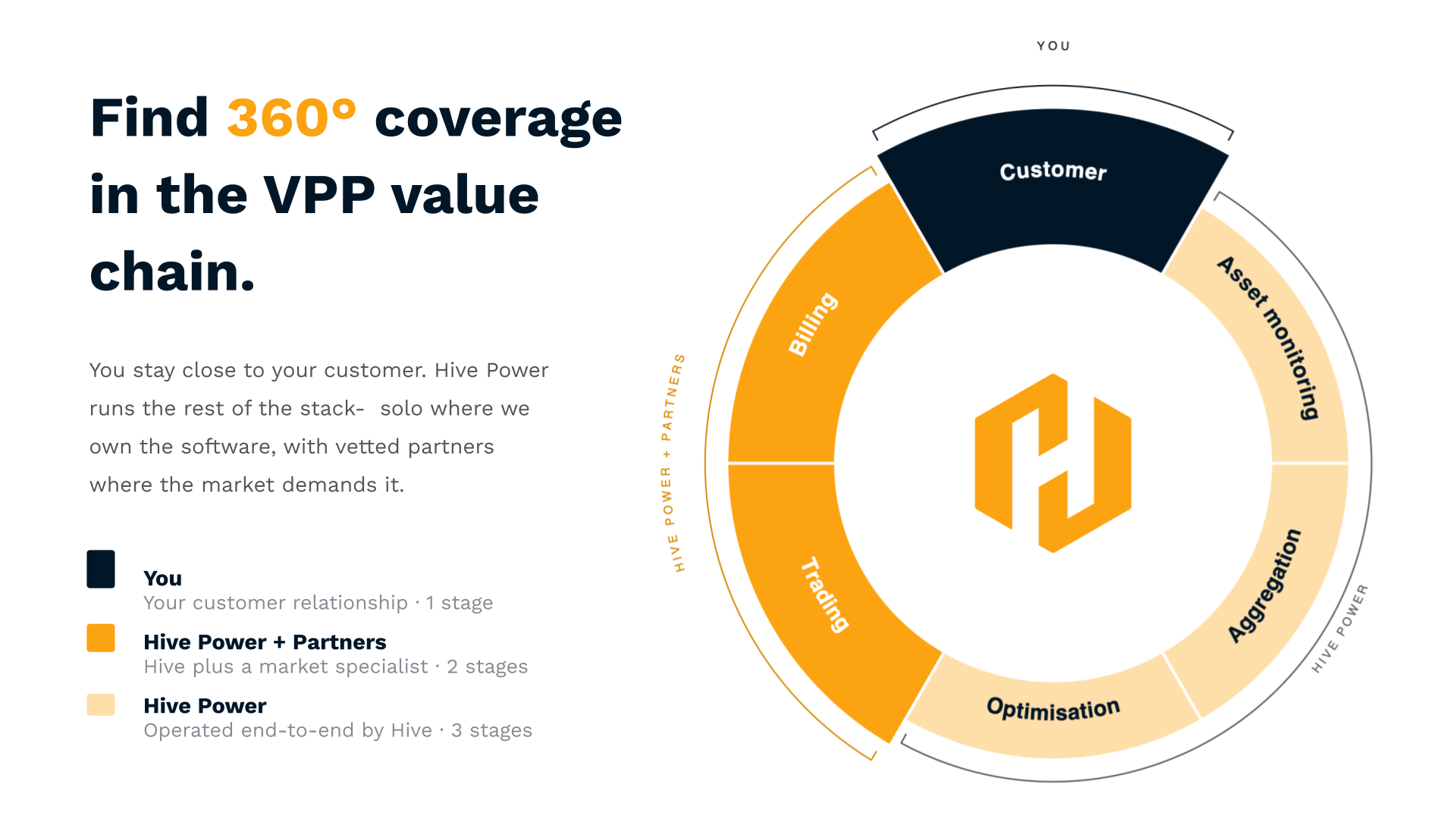
Running a virtual power plant means keeping six distinct functions working in sequence: asset monitoring, aggregation, optimisation, trading, billing, customer management. Most vendors in this space handle one or two of those well. The gap between what a vendor covers and what an operator actually needs is where most VPP projects stall.
At Hive Power, we built to cover the full chain. Through FLEXO, our flexibility orchestrator, and through our network of trading and ecosystem partners, we have a role at every layer. This article walks through what each layer involves and why coordinated coverage across all of them changes the economics.
The VPP Value Chain
Customer Management
Every distributed energy resource has an owner or operator behind it: a fleet manager, a charge point operator, a building manager, and end users. Onboarding those relationships, maintaining asset consent, and providing an intuitive interface to users is where the value chain begins. Get this wrong, and nothing downstream will matter, because no assets are ever connected.
Asset Monitoring
Real-time visibility into each asset is the foundation of every decision further down the chain. State of charge, connection status, metering data, forecasted availability: these signals feed optimisation, aggregation, and dispatch.
Aggregation
Most individual assets are too small to participate directly in wholesale or ancillary service markets. Aggregation pools distribute resources into a virtual portfolio with enough capacity, predictability, and geographic spread to meet TSO and DSO qualification requirements. It also handles bid construction: converting raw flexibility into structured market offers with the right format, timing, and volume.
Optimisation
Given asset availability, market prices, grid signals, and customer preferences, the optimisation layer decides when to charge, discharge, curtail, or shift load, and at what rate. The objective is to maximise value across multiple use cases simultaneously: price arbitrage, frequency reserves, self-consumption, congestion relief. This is the core of what FLEXO does.
Trading
Optimised bids need to reach the right markets at the right time. Trading covers offer submission to spot, intraday, and ancillary service markets, imbalance management, settlement, and direct interfaces with TSO or DSO procurement systems. In most European markets, this requires a licensed trading entity with established counterparty relationships. This is where our network of energy market partners becomes extremely advantageous.
Billing
Revenue flows back to asset owners through settlement and billing. The process needs to be transparent and auditable, and align with the contractual structure agreed with each participant.
Why the Handoffs Are Where Value Gets Lost
Each layer is technically complex on its own. But the interactions between them are where most revenue is either captured or missed.
An optimisation engine recommends discharging a BESS portfolio during a peak pricing window. That recommendation is only as good as the monitoring data feeding it. If state-of-charge readings are delayed by two minutes, the dispatch misses the window. The revenue disappears and the imbalance goes to settlement at an unfavourable price.
Fragmented stacks, where monitoring comes from one vendor, optimisation from another, and trading from a third, introduce latency, data loss, and coordination overhead at every handoff. Each vendor optimises for their own layer. No one is accountable for the chain.
How Hive Power Covers the Full Stack
We work across the VPP value chain in two ways: directly through FLEXO, and through structured partnerships where specialist expertise adds more value than replication would.
FLEXO covers asset connectivity and monitoring via standardised APIs and device integrations, real-time multi-objective optimisation, aggregation logic including bid construction and the customer-facing layer. It is modular, which means it can be deployed for a single use case, such as smart charging optimisation for a CPO, or for a full VPP stack combining batteries, EVs, and building systems across multiple markets.
Trading partners bring licensed market access and TSO or DSO relationships in specific countries. Building those relationships from scratch takes years. Rather than replicate them, we integrate with specialist trading entities who handle offer submission, settlement, and imbalance management. FLEXO provides the signals; the trading partner executes in the market.
Ecosystem partners extend coverage to asset types and geographies where a specialist has already established infrastructure, which is particularly relevant for BESS manufacturers, EV OEMs, and CPO platforms.
Conclusion
The market for distributed flexibility is growing fast across Europe. Capturing it requires coordinated coverage across every layer of the VPP value chain, from the asset and the customer relationship through to the trade and the settlement.
If you are operating distributed assets and want to understand how your portfolio could participate more actively in flexibility markets, we would be glad to walk you through the value chain.


Comments