
Why C&I battery projects fail
Most C&I battery projects that fail don't fail because of the battery.
At the European C&I Energy Storage and Management Summit, we saw a slide from EY: it ranked the reasons C&I battery projects get stuck, and technology came last. Commercials, regulation, financing and tax all came first.
This is exactly what we see every day. Mature LFP cells and standard warranties are rarely the root cause. The market is growing fast, revenues are changing quickly, and the rules are being rewritten while many projects are still being planned.
What's happening in the market right now
There are more opportunities for C&I batteries than ever, but the easiest revenues are shrinking. Here are five trends from the past few months:
- C&I storage is growing fast. In 2026, Europe installed more energy storage than the US for the first time. Wood Mackenzie now describes C&I as a segment that's finally starting to grow. Prices are falling too: EUPD Research expects more stock arriving in Europe to push C&I system prices down towards the end of the year. Hardware isn't what holds projects back.
- aFRR prices are falling. A two-hour battery in Germany could have earned about €191k/MW per year in August, 15% less than in August 2025. Modo Energy reports that aFRR-up capacity cleared at €7.35/MW/h, half of last year's level. A year ago aFRR made up 88% of the revenue stack, and now it's about half. France and Spain show the same pattern, as we explained in our post "Germany's aFRR gold rush is closing".
- Grid fees are changing. From 2029, Germany's AgNes reform will charge new grid-connected batteries a capacity fee of about €4 to €7 per kW per year. Projects only keep today's exemption if they make their final investment decision before 1 January 2027 and connect by 4 August 2029 (Cube Concepts). The Bundesnetzagentur's final decision is expected before the end of the year.
- Data centres need batteries to get connected. In Europe's main hubs, new data centres can wait seven to ten years for a grid connection. An on-site battery combined with a flexible connection agreement can shorten that wait, and the servers keep running at full power.
- EV charging hubs are adding batteries. Charge point operators are installing storage next to high-power chargers so they don't have to pay for expensive grid upgrades. Atlante's 600 kW hub in Tuscany and battery-backed chargers at UK motorway services are two recent examples (Flexecharge, EV Charging Infrastructure).
All five trends point the same way. More batteries are being installed behind the meter, and the rules around revenue, regulation and financing are changing faster than the technology.
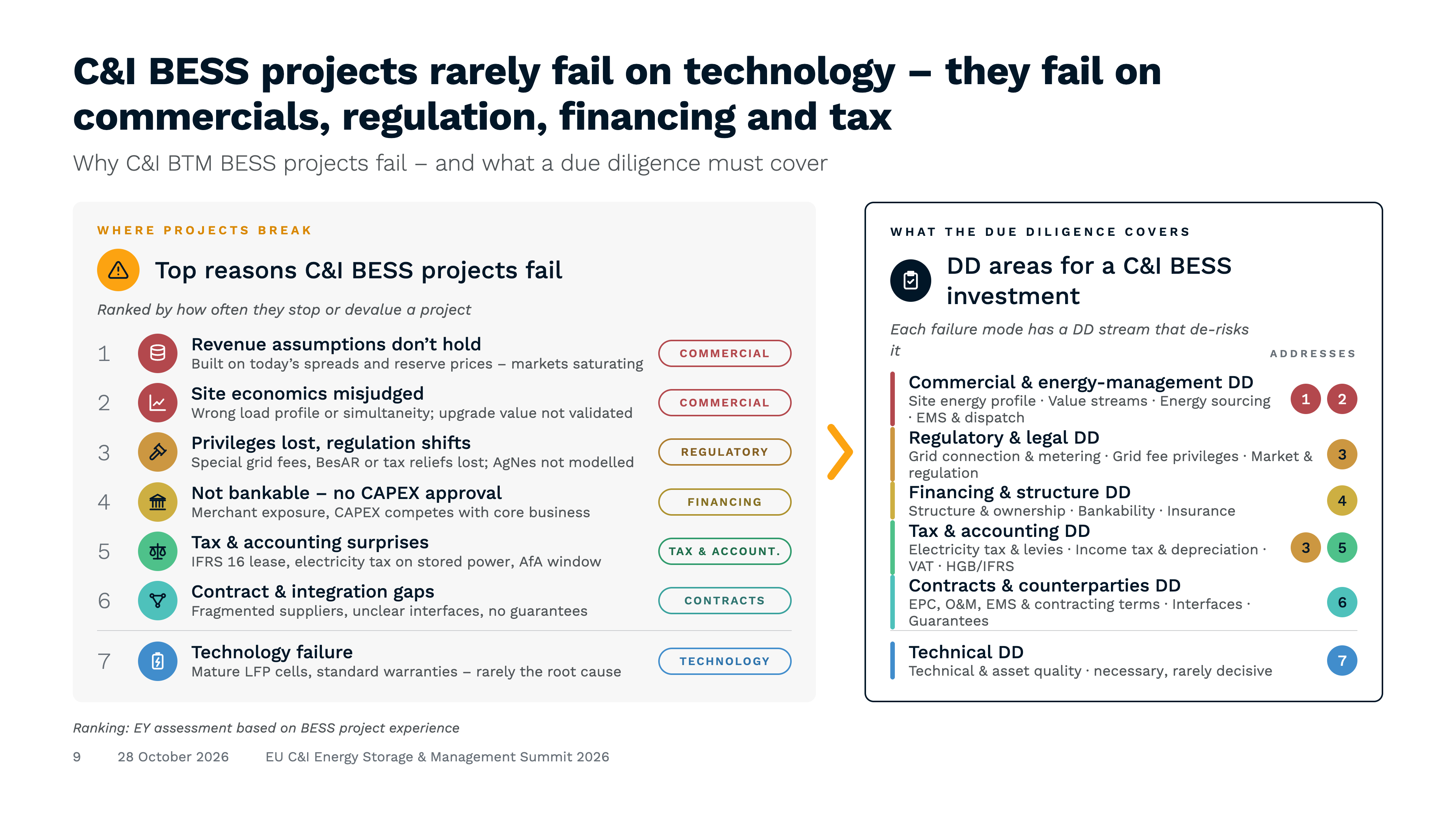
Where C&I projects really break
1. Commercials
The revenue case often doesn't hold once you add real tariffs, market access and operating costs. Many business cases are still built on last year's spreads and reserve prices. The aFRR figures above show why that's risky: a model based on 2025 capacity prices would already be wrong by half. The site matters too. A wrong load profile, a misjudged simultaneity factor or a grid-upgrade saving that nobody checked can wipe out the margin.
2. Regulation
Grid connection rules, network fees and market requirements vary from country to country, and they can change from year to year. AgNes is a clear example. Two identical batteries can pay nothing in grid fees or tens of thousands of euros a year, depending on when the investment decision was signed. Prequalification rules, metering requirements and the treatment of behind-the-meter assets also differ in every market we work in.
3. Financing
Lenders want predictable cash flows. If a battery earns most of its money on volatile markets, you need a clear plan to convince them. Most European BESS debt in Q3 2026 was backed by contracted revenue, according to Modo Energy. At the Battery Business & Development Forum this spring, bankers said they increasingly ask for tolling agreements or revenue floors (ESS News). C&I sites face another hurdle: the battery competes for CAPEX with the company's core business. So the downside case needs to be as convincing as the upside.
4. Tax
VAT, electricity tax and depreciation rules can change the numbers more than anyone expects. In Germany, stored power was taxed twice until 1 January 2026, and whether on-site storage benefits from the fix depends on how the power flows (Taylor Wessing). Add lease accounting under IFRS 16 and depreciation windows, and tax alone can decide whether a project meets the company's hurdle rate.
Questions to ask before you choose a supplier
If you're planning a C&I battery, check all four areas before you compare datasheets:
- Is your revenue model based on real market data, or on last year's spreads?
- Do you know which markets your battery can access, and what prequalification involves?
- Have you modelled the grid fees and tax rules that will apply when you connect, not the ones that apply today?
- Can you show a lender, or your CFO, how the battery makes money in a bad year?
- Who is responsible for each interface between EPC, O&M, EMS and the market optimiser?
If you're not sure about any of these, that's probably where your project will get stuck.
Get the full guide
Which of these four has caused the most trouble on your projects?
We cover all of this in our latest report, How to Enter the Flexibility Market as a BESS Owner, including how to avoid these pitfalls. Get your copy now: download the report.


Comments